He Explained It Perfectly. Then He Didn't Recognize He Wasn't Doing It.
He Explained It Perfectly. Then He Didn't Recognize He Wasn't Doing It.
This article originally appeared on LinkedIn in Learning Reframe, my monthly newsletter for parents and educators on how the brain learns.
May is more revealing than most people realize.
Report cards describe what a child produced. They don't describe what's happening right now, in the last few weeks of the year. May is revealing because the last few weeks of the school year put something specific under pressure: the difference between what a child understands and what a child can do on their own.
All year, learning happens inside a structure. There are prompts. There are checkpoints. There are teachers asking the next question before a student has to come up with it themselves. That structure holds a lot of things together that haven't yet become second nature.
In May, that structure gets thinner. End-of-year fatigue sets in. Review replaces new instruction. Students rely on what already feels comfortable rather than engaging with anything new. The difference between what a child knows and what they can produce without support becomes visible in a way it wasn't in October.
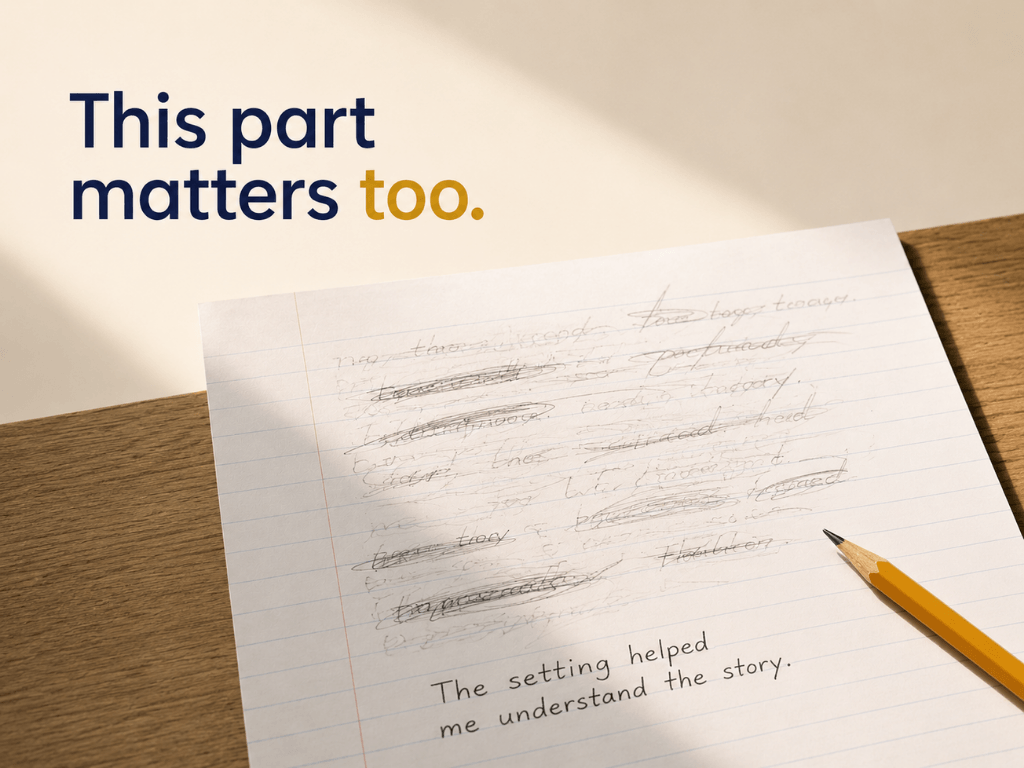
What you'll be able to do by the end of this article:
Recognize the difference between a child understanding a concept and being able to use it without support
Understand why that difference has nothing to do with effort or attention
Try one specific question and one independent attempt with a child this week that tells you more than any grade will
There is a reason this happens and it has nothing to do with effort or attention.
A child can hear a concept explained, follow along, answer correctly when asked, and still be unable to do the same thing when no one is guiding them. Not because they weren't paying attention. Not because they don't care. Because hearing something explained and being able to use it independently are two different things.
Think of it this way. A child can hear how to ride a bike described perfectly and still need a hand on the back of the seat. The description is in their head. The skill isn't in their body yet. Learning a concept works the same way. Understanding it when someone walks you through it is the first step. Being able to use it alone, without prompting, is a different step. It takes more time and more practice to get there.
A student I work with can tell you exactly what a complete sentence needs. Ask him and he'll say it clearly: a subject, a predicate, a complete thought. In that same session, he wrote a sentence with only a subject and stopped there. He thought it was finished. He didn't recognize that the predicate was missing, even though he'd just described what a complete sentence requires.
He understood the concept. He couldn't yet apply it consistently on his own. That's what the last few weeks of the school year make harder to ignore.
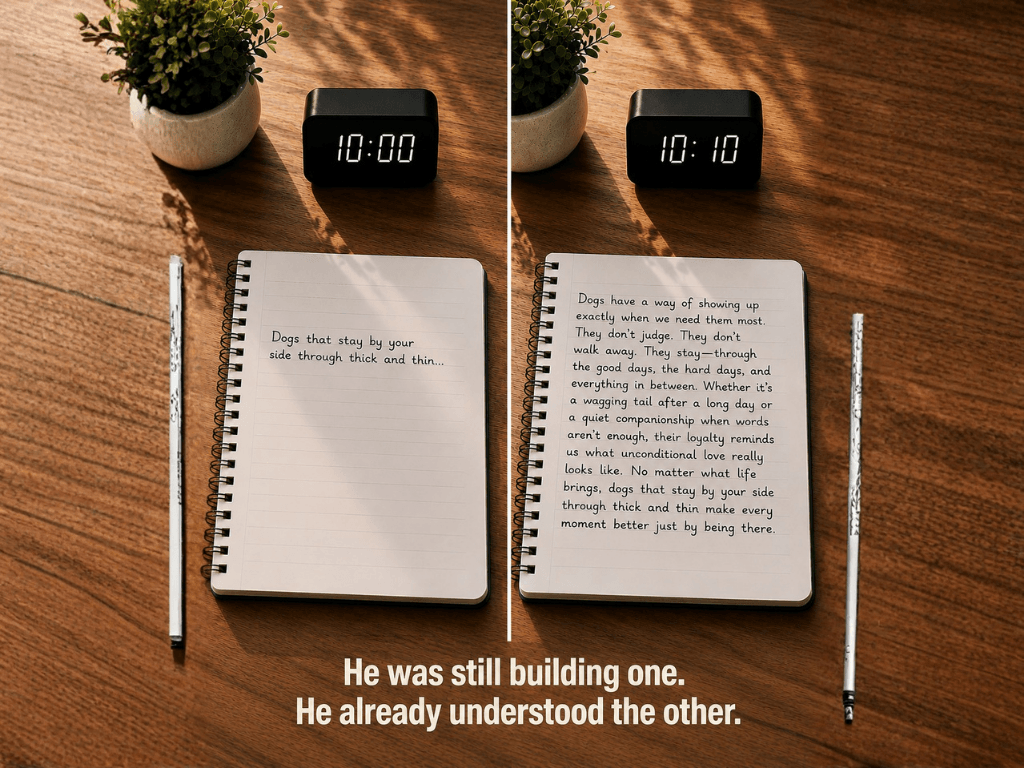
Understanding something and being able to produce it without support are two separate things.
The same student was explaining what a closing sentence does. He said it wraps everything up, then paused and added: "like a burrito." He was completely right. It's one of the most accurate descriptions of paragraph closure I've heard.
Ten minutes earlier, in the same session, he'd written a sentence with only a subject and no predicate. He thought it was a complete sentence. He didn't recognize something was missing.
Both moments happened in the same session, minutes apart. One showed a student who understood a concept deeply enough to describe it accurately in his own words. The other showed the same student unable to recognize when he wasn't applying a concept he could clearly explain. That's not a contradiction. That's what the distance between understanding and independent use looks like in real time.
Here is the reframe: understanding something and being able to produce it without support are two separate things. A child who can't yet use a concept without prompting isn't failing to understand it. The understanding is genuinely there. The independent use is still being built. Those two things require two different responses.
Research on how children learn confirms this. What a child can do with guidance and what a child can do independently are recognized as two distinct levels of development.¹ A child moves from one to the other through practice doing the work on their own, not through more guided instruction alone.
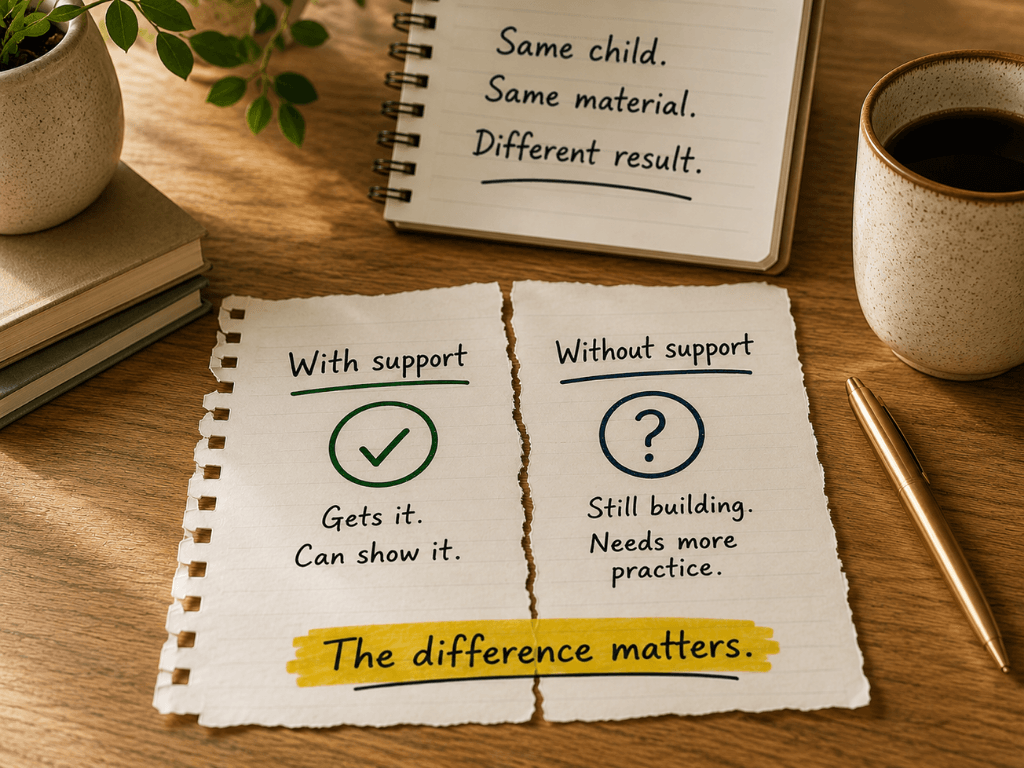
That changes everything. It moves the question from "why can't this child show what they know" to "what does a child need in order to use this without help." Those are very different questions. They lead to very different conversations. The last few weeks of the school year are when that distance becomes harder to miss.
One question and one independent attempt tell you more than a grade will.
After a child finishes studying something, ask them to close everything and explain what they just learned in their own words. Don't prompt them. Don't fill in the pauses. Just listen.
Then ask them to do one example of that same thing on their own, without notes, without guidance, without help.
The explanation tells you whether the understanding is there. The independent attempt tells you whether they can produce it without support. If the explanation is clear and the independent attempt shows something still being built, that's the information. It's not a problem to fix that night. It tells you exactly where the work is, and it's far more useful than knowing how long they sat at the desk.
If this resonated and you want to understand what this looks like for a child you know, The Reframe is a good place to start. It takes about two minutes and helps you see which areas of reading, writing, and learning might be worth looking at more closely.
SOURCES CITED IN THIS POST
¹ Vygotsky, L. S. (1978). Mind in society: The development of higher psychological processes. Cambridge, MA: Harvard University Press.
Learning Reframe is a monthly newsletter for parents and educators on how children actually learn. If this issue raised questions about your child's learning, a Learning Strategy Session is a free 15-minute conversation where you share what you're noticing, and we work out what might be getting in the way.

"I believe in every child I teach. Then I show them why they can believe it too."
~ Alitalia Kirksey, M.Ed.
Alitalia Kirksey, M.Ed., is the founder of Learning Re-Engineered, a learning and literacy education company that teaches K-12 students how to learn, not just what to learn.
With a master's in Learning and Technology, 27 years in education, and specialized training in Lindamood-Bell's Seeing Stars®, Visualizing and Verbalizing®, and On Cloud Nine®, she helps students become stronger readers, clearer writers, and independent learners using evidence-based methods grounded in research on how the brain learns.
Receive everything I'm creating to help your child learn better, directly to your inbox.

Learning Re-Engineered
Learning Re-Engineered is a learning and literacy education company that teaches K-12 students how to learn, not just what to learn. It was founded by Alitalia Kirksey, a learning strategist with an M.Ed. in Learning and Technology and 27 years of experience in education, including specialized training in three Lindamood-Bell programs. Every program and resource here is grounded in research on how the brain actually learns.
Through one-on-one tutoring, game-based learning, independent curriculum, and academic coaching, I help students in grades K through 12 become stronger readers, clearer writers, and independent learners. Everything here is designed to help your child feel seen, capable, and confident.
Whenever you are ready, I am here.
Learning Pathways
Support
© 2020–2026 Learning Re-Engineered. All rights reserved.