Your Child isTrying. That's Not the Problem.
Your Child isTrying. That's Not the Problem.
He read it. He watched it. He answered every question. He still failed the test.
This article originally appeared on LinkedIn in Learning Reframe, my monthly newsletter for parents on how children actually learn.
When I asked him to tell me what the lesson was about without looking at his notes, he couldn't.
Not because he hadn't tried. He had. He'd put in real time and real effort. He just had no idea that the way he'd been practicing was leaving his brain almost nothing to hold onto.
That moment is what this issue is about.
What you'll be able to do by the end of this article:
Recognize the difference between effort and the kind of practice that builds lasting memory
Understand why certain common study habits feel productive but produce weak retention
Try one thing with your child this week that gives you real information about how their learning is going
Know which tool to use next based on what you find
Who this is for: Parents of children in grades K through 12 who are putting in time and effort but not seeing the results that effort should produce.
Here's the breakdown.
Something specific is happening underneath the surface.
When your child isn't making progress, the first instinct is often to put in more effort. More practice. More time at the desk.
That instinct is understandable. It's also incomplete.
Effort and the right kind of practice are not the same thing. Research on how memory forms shows that the brain doesn't hold onto information simply because a student spent time with it. The brain is far more likely to hold onto information when it's asked to work with the material actively, retrieving it, connecting it to something already known, or organizing it in a way that makes it easier to find later.
Rereading on its own is largely passive. Watching a video is largely passive. Answering questions while the text is still open is largely passive. These strategies can have a place, but by themselves, they don't ask the brain to do the kind of work that produces lasting learning.
Research on retrieval practice consistently shows that students who actively recall information from memory retain significantly more than students who reread the same material, even when total study time is identical.¹ A student can spend a full hour on something and retain far less than the effort suggests, not because they didn't try, but because the strategy behind the effort wasn't aligned with how memory actually forms.²
This is what it looks like in practice.
Passive strategies look productive. Active strategies build memory. Here's the difference.
Passive (feel productive but produce weak retention)
Rereading the same text multiple times
Highlighting or underlining without follow-up recall
Reviewing notes by reading them over
Answering questions with the text still open
Watching a video without pausing to self-test
Active (effortful and more effective for memory)
Closing the book and recalling what was just read in their own words
Using flashcards for self-quizzing after the material is put away
Explaining the concept out loud without looking at notes
Writing a summary after the text is closed
Applying the concept to a new problem or scenario
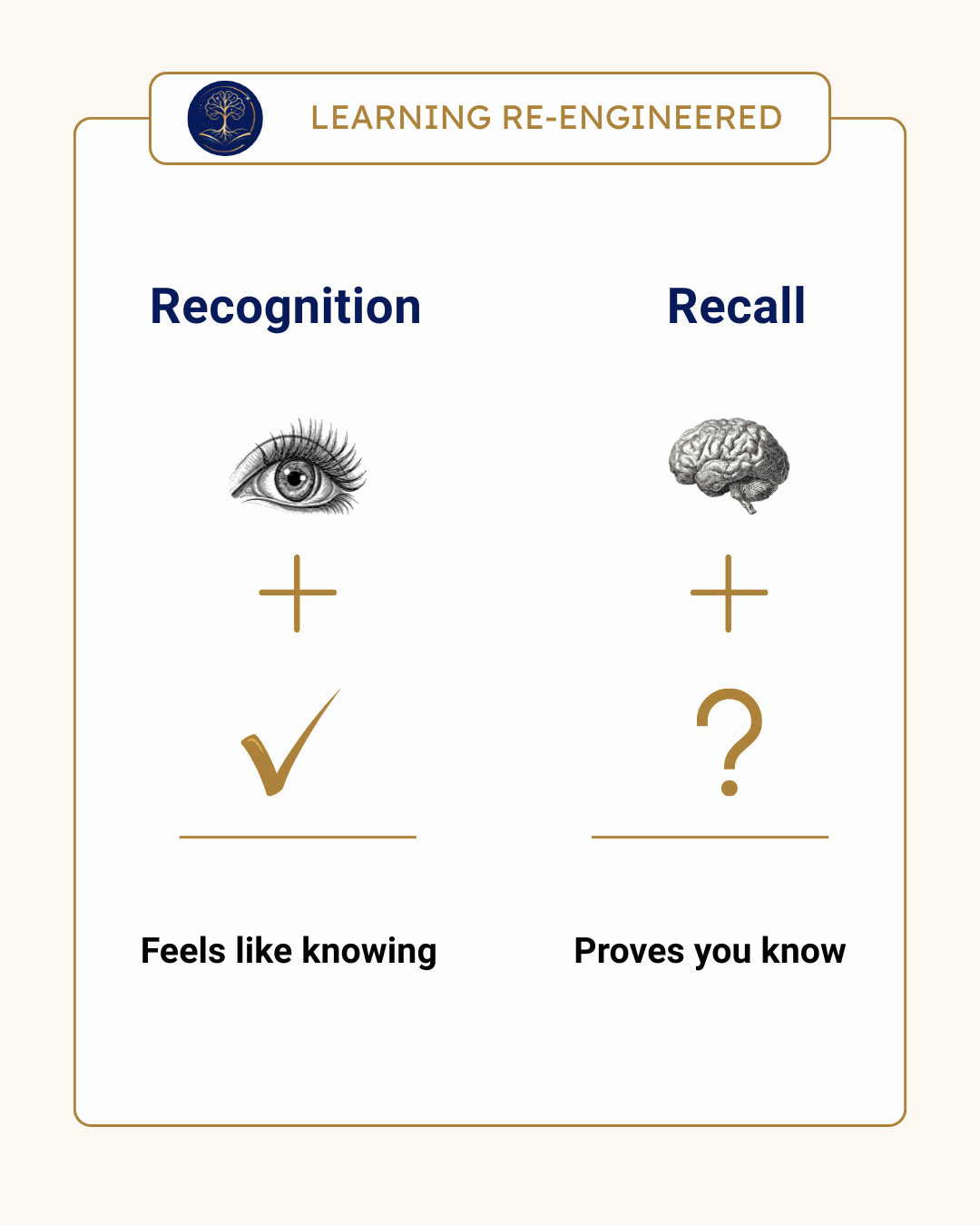
The difference isn't how much time a student spends. It's whether the brain is being asked to retrieve or simply recognize.
See what's actually happening during study time.
Passive strategies look like active ones from the outside. Rereading looks like studying. Recopying notes looks like studying. Reviewing a highlighted page looks like studying. It all looks the same until you know what to look for.
The Study Strategy Observation Tool walks you through one study session so you can see whether what your child is doing actually matches how memory forms. It takes about five minutes.
This is what it means for your child.
When a child works hard and still doesn't show progress, the instinct is often to question their focus, their motivation, or their ability.
Before you go there, consider this instead.
What if your child's effort is real and the approach just isn't aligned with how the brain learns? Research shows that conditions which feel easy and productive in the moment often produce weaker retention than conditions that feel more effortful. The effort itself is what strengthens the memory.³ While much of this research was conducted with older students and adults, the underlying principle is consistent with what research on children's memory and learning also shows: retrieval and effortful practice produce more durable learning than passive review.
That reframe changes everything. It moves the question from "why isn't my child trying hard enough" to "what kind of practice works for how my child's brain processes and retains information." Those are very different questions and they lead to very different conversations.
Your child's effort isn't the problem. The strategy behind the effort is where the work begins.
Try this with your child.
After your child finishes reading or studying something, ask them to close the book or put down the notes and tell you what they just learned in their own words.
Don't let them look back at the page. Don't prompt them with the answers. Just listen.
What your child can recall without looking is a good indication of what their brain has held onto so far. What they can't recall, even after studying it, is where the real work is.
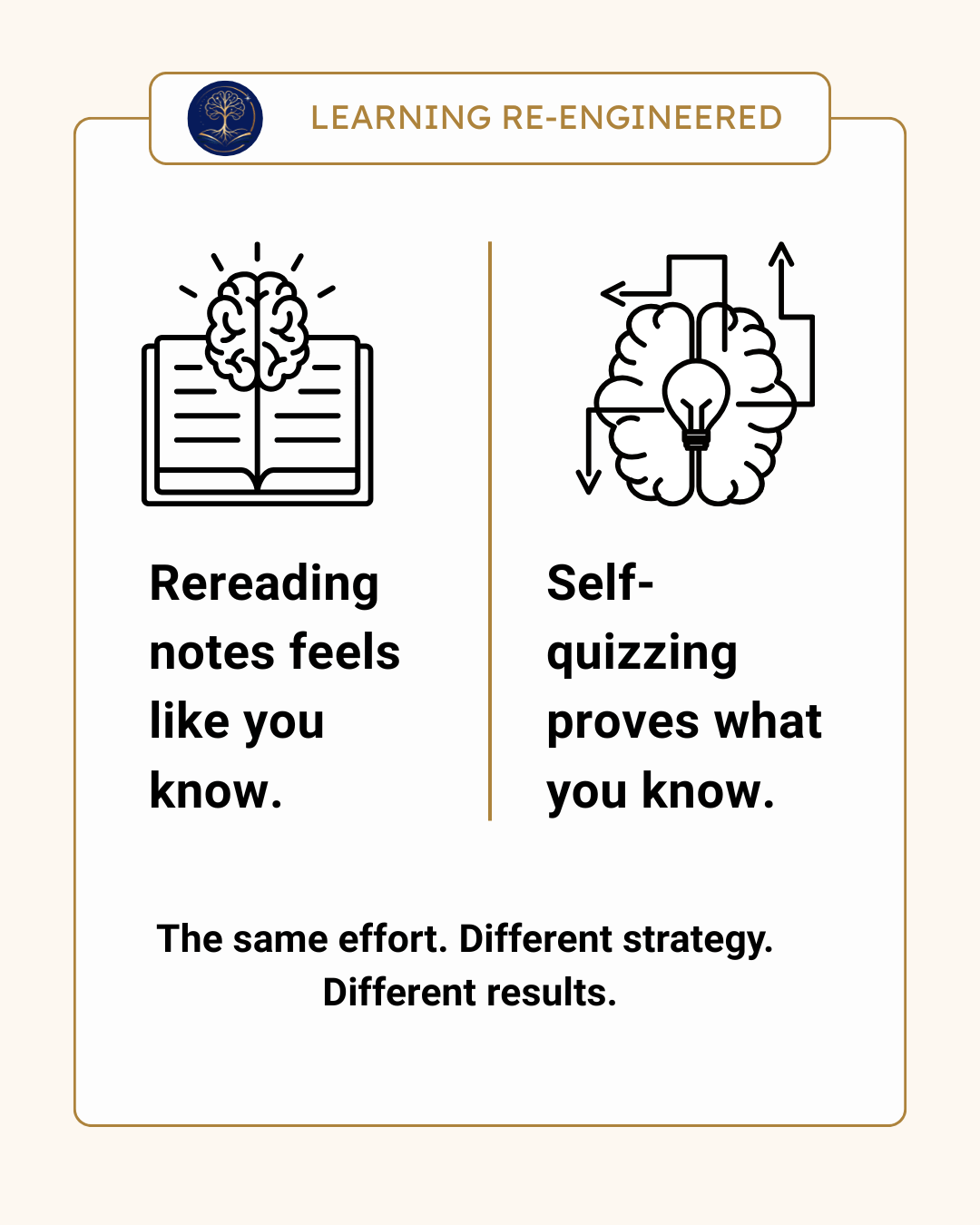
This isn't a test. It's information. It tells you how well the strategy matched how memory works, and it's far more useful than knowing how long they sat at the desk.
This is what to do with what you find.
If you tried the exercise above and noticed that your child could recall very little, or that what they described was surface-level, that's useful data. It tells you that the strategy behind their effort needs attention.
If you want to understand what this looks like specifically for your child, which areas of reading, writing, and learning might be worth looking at more closely, start with The Reframe: Why Isn't It Sticking.
It takes about two minutes and helps you see where the most important questions are.
SOURCES CITED IN THIS POST
¹ Roediger, H. L., and Karpicke, J. D. (2006). Test-enhanced learning: Taking memory tests improves long-term retention. Psychological Science, 17(3), 249-255.
² Karpicke, J. D., and Roediger, H. L. (2008). The critical importance of retrieval for learning. Science, 319(5865), 966-968.
³ Bjork, R. A. (1994). Memory and metamemory considerations in the training of human beings. In J. Metcalfe and A. Shimamura (Eds.), Metacognition: Knowing about knowing. MIT Press.
Learning Reframe is a monthly newsletter for parents on how children actually learn. If this issue raised questions about your child's learning, a Learning Strategy Session is a free 15-minute conversation where you share what you're noticing and we work out what might be getting in the way.

"I believe in every child I teach. Then I show them why they can believe it too."
~ Alitalia Kirksey, M.Ed.
Alitalia Kirksey, M.Ed., is the founder of Learning Re-Engineered, a learning and literacy education company that teaches K-12 students how to learn, not just what to learn.
With a master's in Learning and Technology, 27 years in education, and specialized training in Lindamood-Bell's Seeing Stars®, Visualizing and Verbalizing®, and On Cloud Nine®, she helps students become stronger readers, clearer writers, and independent learners using evidence-based methods grounded in research on how the brain learns.
Receive everything I'm creating to help your child learn better, directly to your inbox.

Learning Re-Engineered
Learning Re-Engineered is a learning and literacy education company that teaches K-12 students how to learn, not just what to learn. It was founded by Alitalia Kirksey, a learning strategist with an M.Ed. in Learning and Technology and 27 years of experience in education, including specialized training in three Lindamood-Bell programs. Every program and resource here is grounded in research on how the brain actually learns.
Through one-on-one tutoring, game-based learning, independent curriculum, and academic coaching, I help students in grades K through 12 become stronger readers, clearer writers, and independent learners. Everything here is designed to help your child feel seen, capable, and confident.
Whenever you are ready, I am here.
Learning Pathways
Support
© 2020–2026 Learning Re-Engineered. All rights reserved.