INSTRUCTIONAL DESIGN CASE STUDY
How do you build a faith-integrated lesson a student remembers?
What happens when a learning experience is engineered for focus, designed for meaning, and built around how the brain actually builds memory that stays.
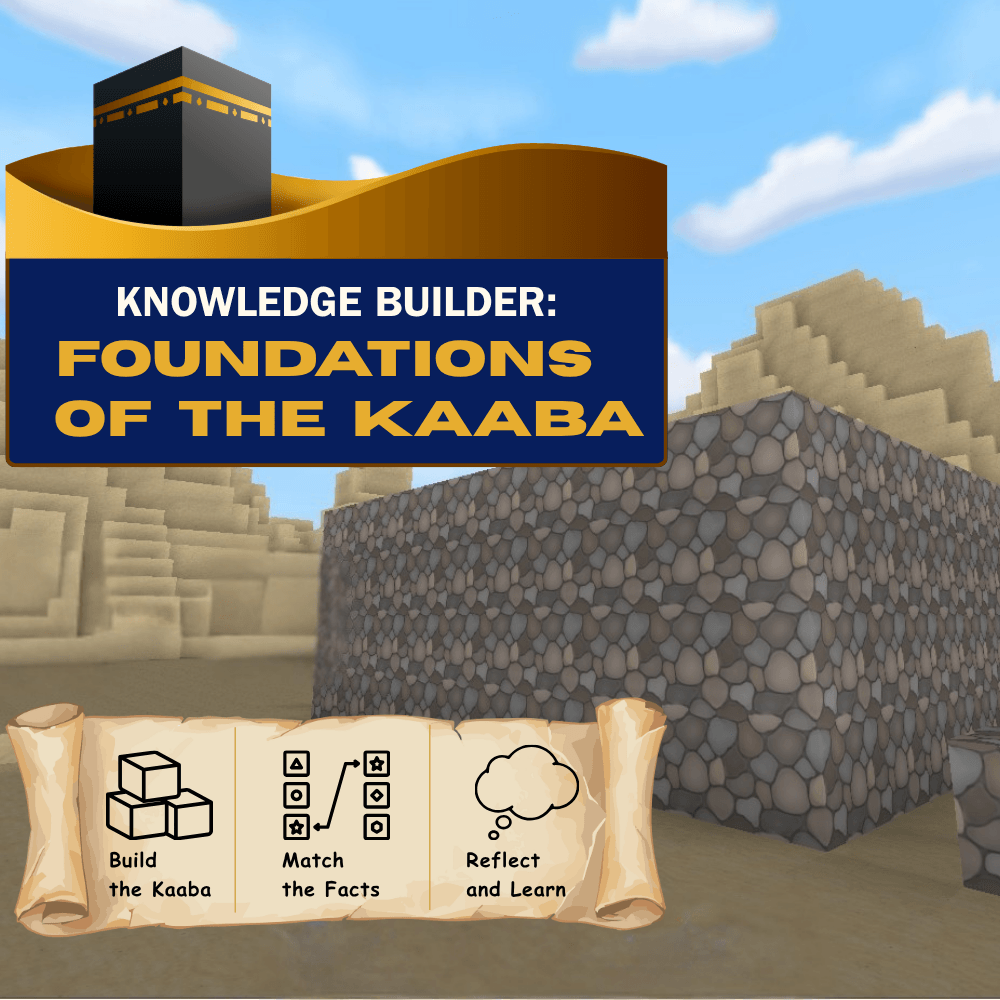
See the instructional design in action.
This video walks through the Knowledge Builder activity, the brain science behind every design decision, and the learning outcomes it produces.
Most educational activities train recognition. This one was built for recall.
There is a difference between a student who recognizes information and a student who actually knows it. Recognition says I have seen this before. Knowing means you can recall it when the page is no longer in front of you.
Most educational activities are building recognition without realizing it. They think they are building knowledge. They are building familiarity.
Familiarity does not stay. Knowledge does.
This case study documents how the Knowledge Builder: Foundations of the Kaaba was designed to produce the second kind of learning:
Durable
Transferable
And grounded in how the brain actually builds memory.
The question that drove every decision was not what students need to know.
It was: what do you picture?
That is the entry point for durable understanding. Before a student can hold a concept, they need to form a mental image of it. Not a summary. Not a definition. An actual picture in their mind.
The move from "what do you think?" to "what do you picture?" changes what the brain is asked to do. It requires the brain to build something rather than respond to something.
That is where real understanding begins.
Four things are working at the same time in every part of this activity.
Everything in this activity is grounded in how the brain actually builds memory. These four steps are not strategies added on top of the lesson. They are the structure of the lesson.
1: Interaction
When students physically do something with content rather than just reading it, watching a video, or sitting through a lecture, the brain stores the information more effectively. Moving, deciding, and building are all part of how memory forms.
2: Retrieval
When a student has to recall specific information from memory before being shown the answer, that act of recalling is what makes the memory stronger. Every time a student successfully recalls something, that memory becomes harder to lose.
3: Reflection
When students are asked to notice how they learned, not just what they learned, they build awareness about their own learning process. That awareness is something they can use the next time they face something new or difficult.
4: Transfer Knowledge
When a student can take what they learned here and use it somewhere else on their own, that is how you know real understanding was built and not just familiarity.
Students do not read about the Kaaba from a distance. They step into the story.
Knowledge Builder: Foundations of the Kaaba was built for Grades 1 through 5 on a three-dimensional platform called Koala Go.
Students step into the valley of Makkah, place the stones of the foundation, drag the Black Stone into its corner, and uncover the well of Zamzam.
They are not clicking through information. They are making deliberate, connected decisions inside a story that actually happened. The content is Islamic history. The design is built around how the brain learns. Every single step was built to produce understanding that lasts.
What students do:
Place the stones of the Kaaba's foundation
Drag the Black Stone into its designated corner
Uncover the well of Zamzam
Complete a retrieval-based matching activity
Reflect on how they learned
How the environment supports learning:
Removes everything that competes with the content for attention
Keeps the visuals spacious and the pacing unhurried
Ensures every element in the space serves the story
Gives working memory one job: the learning itself
Every action in this activity is connected to something that actually happened. Nothing is there just to make the activity feel interactive.
Every task in this activity is tied to the actual story.
Students place stone blocks because Ibrahim and Ismail placed stone blocks. They drag the Black Stone into a corner because that is where the Black Stone was placed. They uncover Zamzam because Hajar waited, trusted, and the water came.
When a student physically does what the story describes, they form a physical memory connected to that moment. That physical memory is what the student draws on when they try to recall what happened. This is also faith made tangible.
"Our Lord, accept this from us. Indeed, You are the All-Hearing, the All-Knowing." Quran 2:127
When a student pauses in the middle of the activity and quietly says those words while looking at what they have built, they are not demonstrating comprehension. They are experiencing it.
The answers are not visible.
Students have to recall specific information from memory and connect it to the correct match. And they have to get every single one right to unlock the chest.
This is not punitive. It is purposeful.
Every time a student successfully recalls something from memory, that memory becomes stronger. Not from re-reading it. Not from being shown it again. From the act of recalling it themselves.
When a student unlocks the chest, they are not being told they did a good job. They are experiencing evidence that they actually know it. That is a completely different feeling, and one they can build on.
The last scroll does not ask what students learned. It asks how.
"What helped me remember? What did I do when it felt tricky? Where else can I use the same kind of learning?"
Those questions are not a formality. They are the most important part of the activity.
The scholar Ibn Khaldun observed that a student has to struggle with an idea before the understanding becomes durable. The reflection scroll is where that moment of struggle gets recognized and named. When a student can name what helped them remember, they build awareness about how they learn that travels with them into the next thing they encounter.
That is the difference between a student who finishes an activity and a student who grows from one.
This activity produces two kinds of growth, and both matter.
Historical knowledge:
Students finish knowing that Prophet Ibrahim and Ismail raised the foundations of the Kaaba. They know where the Black Stone was placed. They know what Zamzam is and why it matters. They know the Kaaba was built as an act of worship, not just a building project.
Learning skills:
Students have practiced recalling information from memory. They have practiced building understanding step by step. They have practiced noticing what helped them remember.
Those two things reinforce each other. A student who leaves knowing how they learned walks into the next learning experience more capable than before.
This is how learning lasts.
Interaction is how the brain takes ownership of knowledge, not just exposure to it.
Retrieval is how memory becomes reliable, not just familiar.
Reflection is how a student builds awareness about their own learning process.
Transfer is how you know real understanding was built.
These four steps do not sit on top of the lesson. They are the lesson. That is what separates a learning experience that produces understanding from one that produces the feeling of having learned.
Are you ready to experience the Foundations of the Kaaba?
This activity is available now on Learning Quests, a brain-based learning platform built around content that reflects the identities and stories of the students who will encounter it.
Receive everything I'm creating to help your child learn better, directly to your inbox.
Learning Re-Engineered
Learning Re-Engineered is a learning and literacy education company that teaches K-12 students how to learn, not just what to learn. It was founded by Alitalia Kirksey, a learning strategist with an M.Ed. in Learning and Technology and 27 years of experience in education, including specialized training in three Lindamood-Bell programs. Every program and resource here is grounded in research on how the brain actually learns.
Through one-on-one tutoring, game-based learning, independent curriculum, and academic coaching, I help students in grades K through 12 become stronger readers, clearer writers, and independent learners. Everything here is designed to help your child feel seen, capable, and confident.
Whenever you are ready, I am here.
Learning Pathways
Support
© 2020–2026 Learning Re-Engineered. All rights reserved.