Why Kids Forget Over Summer and How Practice Rebuilds Memory
Why Kids Forget Over Summer and How Practice Rebuilds Memory
The last day of school isn't just the start of summer.
It's the start of a season when the brain gets fewer reminders about some skills and more reminders about others. What happens during that season matters more than many families realize.
A student came back to lessons after a month away. Before the break, he had been working on sentence boundaries, learning to hear where one thought ended and the next one began. When he returned, he needed reminders. He needed reteaching. The work that had been building before the break did not carry forward on its own.
That was after one month. For families heading into a summer break, the same pattern has more time to settle in. And what it reveals about how the brain handles a break from practice is worth understanding before summer begins.

Key Takeaways
The brain doesn't erase what a child learned over the summer. When no one asks a child to remember something, the brain gets worse at remembering it quickly.
When a child can't do a skill after a break, that doesn't mean the learning didn't work. It means the brain hasn't been asked to remember it.
Retrieval practice, trying to remember something without looking at the answer, is what keeps the brain able to recall what it learned.
A few minutes of recall practice a few times a week is enough to keep skills from fading without turning summer into school.
The goal isn't a perfect answer. The goal is the effort of trying to remember.
Something specific happens in the brain when consistent practice stops.
When a child comes back after a break and can't do something they were working on before, many families assume the learning didn't stick. That conclusion makes sense based on what they can see. However, what is happening inside the brain is more specific than "the child forgot."
In 1885, Hermann Ebbinghaus studied how quickly people lose the ability to recall newly learned information when they don't review it. His research showed that without any review or practice, the ability to recall what was learned drops steeply within the first few days. The information doesn't disappear from the brain entirely. The brain just gets worse at remembering it quickly.
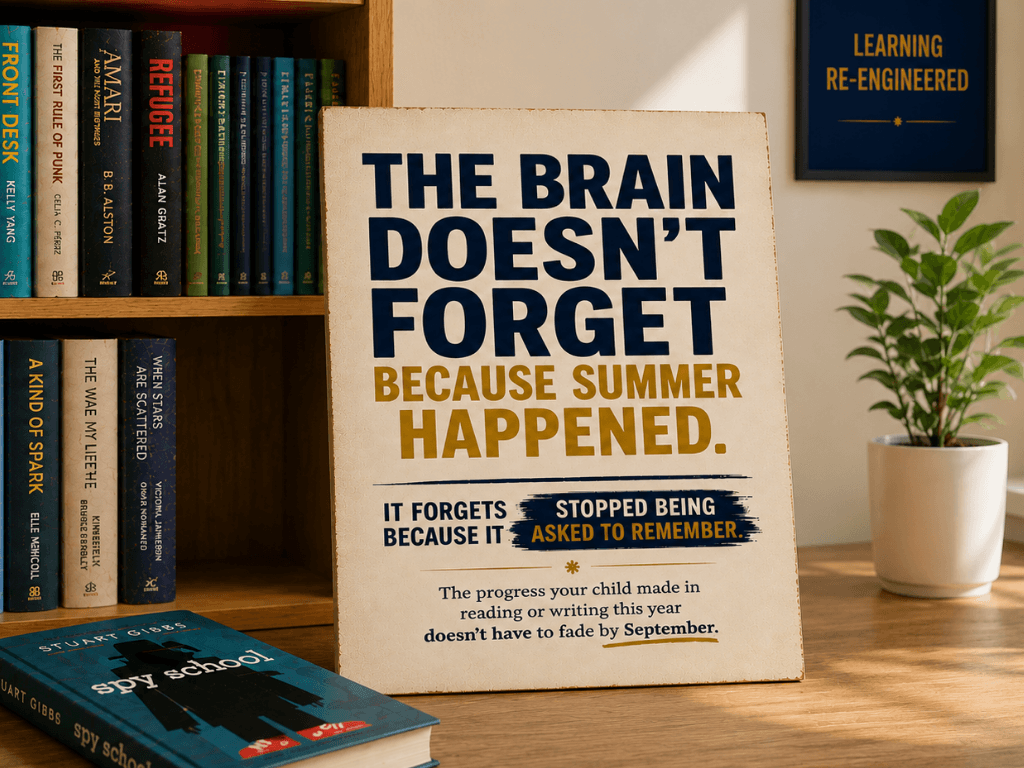
Robert Bjork's research on memory helps explain why. Bjork distinguishes between two kinds of memory strength. The first is how deeply something was learned in the first place. The second is how easily the brain can recall that learning right now. A child who practiced a skill consistently over weeks or months built real depth. That depth doesn't vanish when practice stops. What weakens is the brain's ability to recall the skill quickly and use it without support.
This is what actually happens when a child can't do something in September that they could do in May. It isn't about whether the child learned. It's about whether the brain has been given regular chances to remember what it learned. When those chances disappear for the summer, the brain gets worse at recalling the information. Not because the child forgot, but because no one asked the child to remember.
Understanding that distinction is where the reframe begins.
If you've noticed that a child studies for a test and still doesn't remember the material days later, the same principle applies. When Studying Feels Productive but Learning Still Disappears breaks down why effort and strategy are not the same thing, and what to look for when a child is working hard but not remembering what they learn.
The reframe is that the child didn't fail and the brain isn't broken.
Here is the reframe: a child who can't immediately do something they haven't practiced in weeks or months is not showing a sign of failure. The brain naturally gets worse at recalling skills that aren't being used. This is a normal part of how memory works, not a sign that the instruction didn't work or that the child didn't try hard enough.
And understanding that it's normal is not the same as accepting it. It means there is something specific to do about it.
What rebuilds the brain's ability to remember is not re-reading notes or re-doing old worksheets. Research by Roediger and Karpicke found that actively trying to remember something without looking at the answer strengthens the brain's ability to recall that information in the future more than reviewing the same material does.
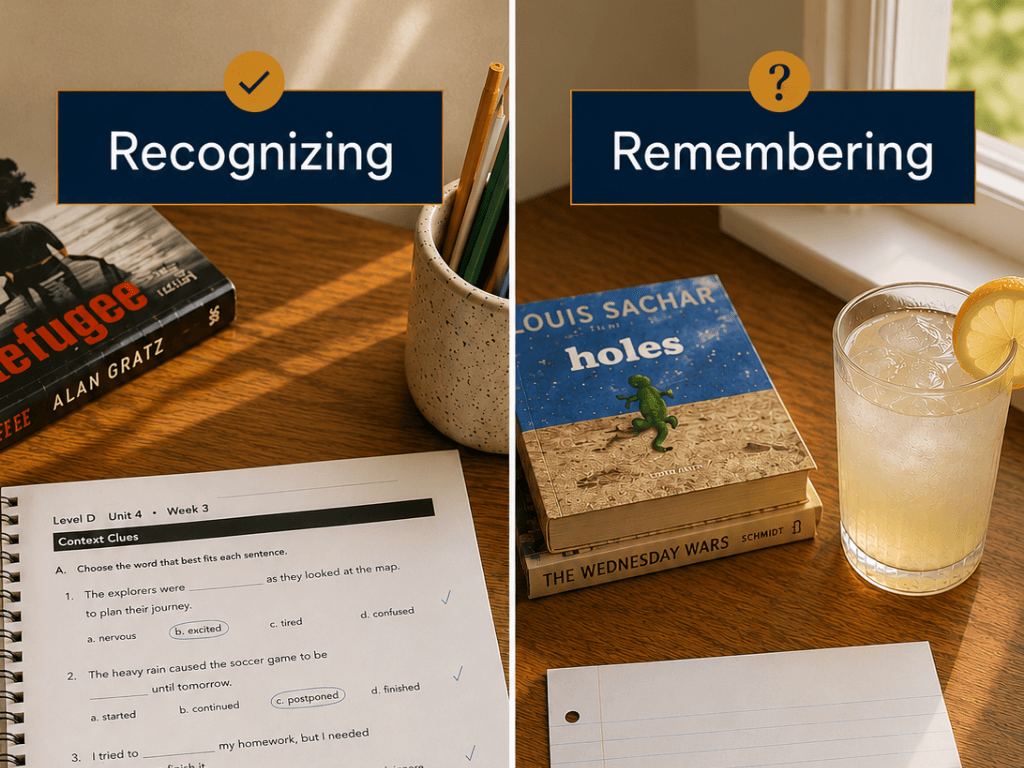
This is why helping a child remember what they learned over the summer isn't about adding more content. It's about giving the brain regular chances to remember what it already learned.
Here is one thing to try: a few minutes of recall practice, a few times a week.
This recommendation comes from what works consistently in tutoring sessions, not from a specific study. The research supports the principle: retrieval practice strengthens the brain's ability to recall information. The specific practice of a few minutes, a few times a week, is what has been enough to keep skills from fading without turning summer into school.
Pick one subject or skill from the school year. A few times a week, ask the child to say what they remember about it. Not from notes. Not from a textbook. From memory.
It can sound like: "Tell me three things you remember about what you read last week." Or: "What was happening in that book you read in March?" The goal isn't a perfect answer. The goal is the effort of trying to remember, because that effort is what keeps the brain able to recall the learning.

If the child says "I don't remember" or "I don't know," that's not a failure. It's the starting point. Narrow the question: "Do you remember whether that story had anything to do with a character making a hard choice?" That smaller question gives the brain something to start with. The next time, ask the original question again without the prompt.
That pattern of trying to remember, getting a prompt, and trying again is what rebuilds the brain's ability to recall the information. No curriculum to follow. No prep required. Just a conversation that asks the brain to remember what it knows.
The earlier learning isn't gone. It needs a path back.
The student who came back after a month away from sentence boundary practice did not have to start over. Within a few sessions of consistent reteaching, he was using the skill again without prompts. The earlier work wasn't wasted. What had weakened was the brain's ability to recall the skill quickly. Once that was rebuilt through practice, the skill came back faster than it had taken to build the first time.
That is what regular practice does for children over time. It doesn't add new content. It keeps the brain able to recall what was already learned. And because the brain can still recall it, the child doesn't have to treat it as new information each time.
Every child who built something real during the school year still has that foundation. Summer doesn't erase it. The right kind of practice can keep it within reach.
Where to begin?
A few minutes. A few times a week. One skill. One question. Let the child try to remember what they know, prompt when they need it, and try again.
That is a summer practice that is brain-based, low-pressure, and enough to make September feel different.
Your child has the capacity to grow. These months don't have to work against that.
If you want to understand what else might be behind your child's learning patterns, start with the free parent resource below.
SOURCES REFERENCED IN THIS POST
Ebbinghaus, H. (1885). Über das Gedächtnis: Untersuchungen zur experimentellen Psychologie. Leipzig: Duncker and Humblot.
Bjork, R. A. (1994). Memory and metamemory considerations in the training of human beings. In J. Metcalfe and A. Shimamura (Eds.), Metacognition: Knowing about knowing (pp. 185-205). MIT Press.
Roediger, H. L., and Karpicke, J. D. (2006). Test-enhanced learning: Taking memory tests improves long-term retention. Psychological Science, 17(3), 249-255.
Learning Reframe is a monthly newsletter for parents and educators on how children actually learn. If this issue raised questions about your child's learning, a Learning Strategy Session is a free 15-minute conversation where you share what you're noticing, and we work out what might be getting in the way.

"I believe in every child I teach. Then I show them why they can believe it too."
~ Alitalia Kirksey, M.Ed.
Alitalia Kirksey, M.Ed., is the founder of Learning Re-Engineered, a learning and literacy education company that teaches K-12 students how to learn, not just what to learn.
With a master's in Learning and Technology, 27 years in education, and specialized training in Lindamood-Bell's Seeing Stars®, Visualizing and Verbalizing®, and On Cloud Nine®, she helps students become stronger readers, clearer writers, and independent learners using evidence-based methods grounded in research on how the brain learns.
Receive everything I'm creating to help your child learn better, directly to your inbox.

Learning Re-Engineered
Learning Re-Engineered is a learning and literacy education company that teaches K-12 students how to learn, not just what to learn. It was founded by Alitalia Kirksey, a learning strategist with an M.Ed. in Learning and Technology and 27 years of experience in education, including specialized training in three Lindamood-Bell programs. Every program and resource here is grounded in research on how the brain actually learns.
Through one-on-one tutoring, game-based learning, independent curriculum, and academic coaching, I help students in grades K through 12 become stronger readers, clearer writers, and independent learners. Everything here is designed to help your child feel seen, capable, and confident.
Whenever you are ready, I am here.
Learning Pathways
Support
© 2020–2026 Learning Re-Engineered. All rights reserved.